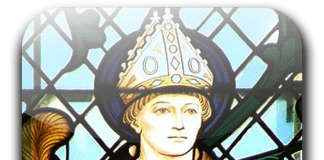
Born into a military family in 10th-century England, Oswald was a nephew of the archbishop of Canterbury, who raised him and played a crucial role in his early education. Oswald continued his studies abroad in France, where he became a Benedictine monk. Following his appointment as bishop of Worcester, and later as archbishop of York, [...]
Born into a military family in 10th-century England, Oswald was a nephew of the archbishop of Canterbury, who raised him and played a crucial role in his early education. Oswald continued his studies abroad in France, where he became a Benedictine monk.
Following his appointment as bishop of Worcester, and later as archbishop of York, he founded monasteries and introduced many reforms. He supported—and improved—scholarship at the abbeys he established, inviting leading thinkers in such fields as mathematics and astronomy to share their learnings.
He was widely known for his sanctity, especially his love for the poor. The final winter of his life was spent at the cathedral in Worcester that he so loved. At the start of Lent in February of the year 992, he resumed his usual practice of washing the feet of 12 poor men each day. On Leap Year Day, February 29, he died after kissing the feet of the 12th man and giving a blessing.
The news of Oswald’s death brought an outpouring of grief throughout the city.
Jonah 3:1-10 Psalm 51:3-4, 12-13, 18-19 Luke 11:29-32 Jonah 3: 1 – 10 1 Then the word of the LORD came to Jonah the second time, saying, 2 “Arise, go to Nin’eveh, that great city, and proclaim to it the message that I tell you.” 3 So Jonah arose and went to Nin’eveh, according to the [...]
Jonah 3:1-10
Psalm 51:3-4, 12-13, 18-19
Luke 11:29-32
Jonah 3: 1 – 10
1 Then the word of the LORD came to Jonah the second time, saying, 2 “Arise, go to Nin’eveh, that great city, and proclaim to it the message that I tell you.”
3 So Jonah arose and went to Nin’eveh, according to the word of the LORD. Now Nin’eveh was an exceedingly great city, three days’ journey in breadth. 4 Jonah began to go into the city, going a day’s journey. And he cried, “Yet forty days, and Nin’eveh shall be overthrown!”
5 And the people of Nin’eveh believed God; they proclaimed a fast, and put on sackcloth, from the greatest of them to the least of them. 6 Then tidings reached the king of Nin’eveh, and he arose from his throne, removed his robe, and covered himself with sackcloth, and sat in ashes. 7 And he made proclamation and published through Nin’eveh, “By the decree of the king and his nobles: Let neither man nor beast, herd nor flock, taste anything; let them not feed, or drink water, 8 but let man and beast be covered with sackcloth, and let them cry mightily to God; yea, let every one turn from his evil way and from the violence which is in his hands. 9 Who knows, God may yet repent and turn from his fierce anger, so that we perish not?”
10 When God saw what they did, how they turned from their evil way, God repented of the evil which he had said he would do to them; and he did not do it.
Psalms 51: 3 – 4, 12 – 13, 18 – 19
3 For I know my transgressions, and my sin is ever before me.
4 Against thee, thee only, have I sinned, and done that which is evil in thy sight, so that thou art justified in thy sentence and blameless in thy judgment.
12 Restore to me the joy of thy salvation, and uphold me with a willing spirit.
13 Then I will teach transgressors thy ways, and sinners will return to thee.
18 Do good to Zion in thy good pleasure; rebuild the walls of Jerusalem,
19 then wilt thou delight in right sacrifices, in burnt offerings and whole burnt offerings; then bulls will be offered on thy altar.
Luke 11: 29 – 32
29 When the crowds were increasing, he began to say, “This generation is an evil generation; it seeks a sign, but no sign shall be given to it except the sign of Jonah. 30 For as Jonah became a sign to the men of Nin’eveh, so will the Son of man be to this generation. 31 The queen of the South will arise at the judgment with the men of this generation and condemn them; for she came from the ends of the earth to hear the wisdom of Solomon, and behold, something greater than Solomon is here. 32 The men of Nin’eveh will arise at the judgment with this generation and condemn it; for they repented at the preaching of Jonah, and behold, something greater than Jonah is here.
1520 A particular gift of the Holy Spirit. the first grace of this sacrament [ANOINTING OF THE SICK] is one of strengthening, peace and courage to overcome the difficulties that go with the condition of serious illness or the frailty of old age. This grace is a gift of the Holy Spirit, who renews trust and [...]
1520 A particular gift of the Holy Spirit. the first grace of this sacrament [ANOINTING OF THE SICK] is one of strengthening, peace and courage to overcome the difficulties that go with the condition of serious illness or the frailty of old age. This grace is a gift of the Holy Spirit, who renews trust and faith in God and strengthens against the temptations of the evil one, the temptation to discouragement and anguish in the face of death. This assistance from the Lord by the power of his Spirit is meant to lead the sick person to healing of the soul, but also of the body if such is God’s will. Furthermore, “if he has committed sins, he will be forgiven.”
Please feel free to leave your Prayer petitions and know that members of this online Catholic community will pray for your intentions. Also, please remember to pray for the intentions of others, the forgotten holy souls in purgatory, and for the Holy Father’s Intentions! LORD, hear our Prayers!
Please feel free to leave your Prayer petitions and know that members of this online Catholic community will pray for your intentions. Also, please remember to pray for the intentions of others, the forgotten holy souls in purgatory, and for the Holy Father’s Intentions!
LORD, hear our Prayers!
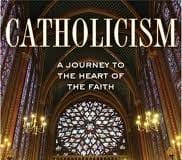
“Catholicism” by Fr. Robert Barron “What I propose to do in this book is to take you on a guided exploration of the Catholic world, but not in the manner of a docent, for I am not interested in showing you the artifacts of Catholicism as though they were dusty objets d’art in a museum [...]
“Catholicism” by Fr. Robert Barron
“What I propose to do in this book is to take you on a guided exploration of the Catholic world, but not in the manner of a docent, for I am not interested in showing you the artifacts of Catholicism as though they were dusty objets d’art in a museum of culture. I want to function rather as a mystagogue, conducting you ever deeper into the mystery of the incarnation in the hopes that you might be transformed by its power.” –Father Robert Barron
What is the Catholicism? A 2,000 living tradition? A worldview? A way of life? A relationship? A mystery? In Catholicism Father Robert Barron examines all these questions and more, seeking to capture the body, heart and mind of the Catholic faith.
Starting from the essential foundation of Jesus Christ’s incarnation, life, and teaching, Father Barron moves through the defining elements of Catholicism – from sacraments, worship, and prayer, to Mary, the Apostles, and Saints, to grace, salvation, heaven, and hell – using his distinct and dynamic grasp of art, literature, architecture, personal stories, Scripture, theology, philosophy, and history to present the Church to the world.
To replace a man like St. Leo the Great was not easy, but the next pope was a man after Leo’s heart, the archdeacon Hilary. Hilary was a Sardinian who had joined the Roman clergy and had been sent by St. Leo as one of the papal legates to the council at Ephesus in 449. [...]
To replace a man like St. Leo the Great was not easy, but the next pope was a man after Leo’s heart, the archdeacon Hilary. Hilary was a Sardinian who had joined the Roman clergy and had been sent by St. Leo as one of the papal legates to the council at Ephesus in 449. This council, intended to settle the Monophysite affair, got out of hand. Packed with Monophysites and presided over by Dioscorus, the patriarch of Alexandria, the assembly refused to listen to the protests of the papal legates. Dioscorus steam-rollered through the council a condemnation of the orthodox and saintly Flavian, patriarch of Constantinople, and an approval of the Monophysite leader Eutyches. In vain Hilary protested. He had to fly in fear for his life and hide in a chapel of St. John the Evangelist. It was only with difficulty that he got back to Rome. No wonder St. Leo called this Ephesus council a gathering of robbers!
As pope, Hilary worked hard to foster order in the Gallic hierarchy. When a certain Hermes illegally made himself archbishop of Narbonne, two Gallic delegates came to Rome to appeal to Pope Hilary. He held a council at Rome in 462 to settle the matter. He also upheld the rights of the see of Arles to be the primatial see of Gaul. From Spain also came appeals of a similar nature. To settle these Hilary held a council at Rome in 465. This is the first Council at Rome whose acts have come down to us. According to the “Liber Pontificalis” he sent a letter to the East confirming the ecumenical councils of Nicaea, Ephesus, and Chalcedon, and the famous dogmatic letter of his predecessor St. Leo to Flavian. He also publicly in St. Peter’s rebuked the shadow-emperor Anthemius for allowing a favorite of his to foster heresy in Rome.
St. Hilary deserves great credit for his work in building and decorating churches in Rome. Of especial interest is the oratory he built near the Lateran, dedicated to St. John the Evangelist. The Pope attributed his escape from the wild Monophysites at Ephesus to the intercession of the Beloved Disciple, and to show his gratitude he built this beautiful oratory. Over its doors may still be seen the inscription, “To his deliverer, Blessed John the Evangelist, Bishop Hilary, the Servant of Christ.” Hilary built two more churches and spent freely in decorating still others. The gold and silver and marble used so lavishly by this Pope in adorning the Roman churches indicate that the wealthy families of Rome must have saved something from the grasping hands of Goths and Vandals.
St. Hilary died on February 29. His feast is kept on February 28.
Isaiah 55:10-11 Psalm 34:4-7, 16-19 Matthew 6:7-15 Isaiah 55: 10 – 11 10 “For as the rain and the snow come down from heaven, and return not thither but water the earth, making it bring forth and sprout, giving seed to the sower and bread to the eater, 11 so shall my word be that goes [...]
Isaiah 55:10-11
Psalm 34:4-7, 16-19
Matthew 6:7-15
Isaiah 55: 10 – 11
10 “For as the rain and the snow come down from heaven, and return not thither but water the earth, making it bring forth and sprout, giving seed to the sower and bread to the eater, 11 so shall my word be that goes forth from my mouth; it shall not return to me empty, but it shall accomplish that which I purpose, and prosper in the thing for which I sent it.
Psalms 34: 4 – 7, 16 – 19
4 I sought the LORD, and he answered me, and delivered me from all my fears.
5 Look to him, and be radiant; so your faces shall never be ashamed.
6 This poor man cried, and the LORD heard him, and saved him out of all his troubles.
7 The angel of the LORD encamps around those who fear him, and delivers them.
16 The face of the LORD is against evildoers, to cut off the remembrance of them from the earth.
17 When the righteous cry for help, the LORD hears, and delivers them out of all their troubles.
18 The LORD is near to the brokenhearted, and saves the crushed in spirit.
19 Many are the afflictions of the righteous; but the LORD delivers him out of them all.
Matthew 6: 7 – 15
7 “And in praying do not heap up empty phrases as the Gentiles do; for they think that they will be heard for their many words. 8 Do not be like them, for your Father knows what you need before you ask him.
9 Pray then like this: Our Father who art in heaven, Hallowed be thy name. 10 Thy kingdom come. Thy will be done, On earth as it is in heaven. 11 Give us this day our daily bread; 12 And forgive us our debts, As we also have forgiven our debtors; 13 And lead us not into temptation, But deliver us from evil.
14 For if you forgive men their trespasses, your heavenly Father also will forgive you; 15 but if you do not forgive men their trespasses, neither will your Father forgive your trespasses.
2521 Purity requires modesty, an integral part of temperance. Modesty protects the intimate center of the person. It means refusing to unveil what should remain hidden. It is ordered to chastity to whose sensitivity it bears witness. It guides how one looks at others and behaves toward them in conformity with the dignity of persons [...]
2521 Purity requires modesty, an integral part of temperance. Modesty protects the intimate center of the person. It means refusing to unveil what should remain hidden. It is ordered to chastity to whose sensitivity it bears witness. It guides how one looks at others and behaves toward them in conformity with the dignity of persons and their solidarity.
Please feel free to leave your Prayer petitions and know that members of this online Catholic community will pray for your intentions. Also, please remember to pray for the intentions of others, the forgotten holy souls in purgatory, and for the Holy Father’s Intentions! LORD, hear our Prayers!
Please feel free to leave your Prayer petitions and know that members of this online Catholic community will pray for your intentions. Also, please remember to pray for the intentions of others, the forgotten holy souls in purgatory, and for the Holy Father’s Intentions!
LORD, hear our Prayers!
Born in Italy into a large family and baptized Francis, he lost his mother when he was only four years old. He was educated by the Jesuits and, having been cured twice of serious illnesses, came to believe that God was calling him to the religious life. Young Francis wished to join the Jesuits but [...]
Born in Italy into a large family and baptized Francis, he lost his mother when he was only four years old. He was educated by the Jesuits and, having been cured twice of serious illnesses, came to believe that God was calling him to the religious life. Young Francis wished to join the Jesuits but was turned down, probably because of his age, not yet 17.
Following the death of a sister to cholera, his resolve to enter religious life became even stronger and he was accepted by the Passionists. Upon entering the novitiate he was given the name Gabriel of Our Lady of Sorrows. Ever popular and cheerful, Gabriel quickly was successful in his effort to be faithful in little things. His spirit of prayer, love for the poor, consideration of the feelings of others, exact observance of the Passionist Rule as well as his bodily penances—always subject to the will of his wise superiors— made a deep impression on everyone.
His superiors had great expectations of Gabriel as he prepared for the priesthood, but after only four years of religious life symptoms of tuberculosis appeared. Ever obedient, he patiently bore the painful effects of the disease and the restrictions it required, seeking no special notice. He died peacefully on February 27, 1862, at age 24, having been an example to both young and old. Gabriel of Our Lady of Sorrows was canonized in 1920.